


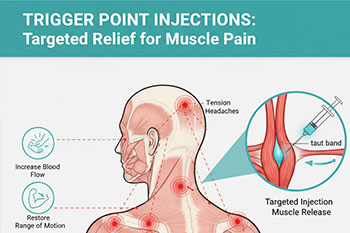
Muscle knots can be painful and stubborn. Trigger point injections are a focused treatment used to relax tight muscle bands, reduce pain, and help you move more comfortably.
What are trigger points?
Trigger points are tight, irritated spots inside muscle tissue. They can feel like small knots and may cause both local pain and pain that spreads to nearby areas.
They often develop from:
- muscle overuse
- repetitive movement
- stress-related tension
- poor posture
- strain from work, exercise, or daily activity
Why do trigger points hurt so much?
A trigger point can keep a muscle in a shortened, irritated state. This can reduce normal movement and keep a pain cycle going.
When a trigger point is active, you may notice:
- aching pain
- stiffness
- reduced range of motion
- tenderness when pressure is applied
How do trigger point injections work?
Trigger point injections are designed to release tight muscle bands and interrupt the pain-spasm cycle.
During treatment, your clinician places a small needle directly into the trigger point. This can help relax the contracted muscle and reduce pain signaling, making it easier to return to stretching, rehab, and normal activity.
What is injected in a trigger point injection?
Depending on your care plan, options may include:
- dry needling (needle only)
- sterile saline
- local anesthetic
- a combination approach
Many patients do well with minimal-medication strategies. Your plan can be tailored to your preferences and goals.
When should I consider trigger point injections?
Trigger point injections are often considered when muscle pain continues despite first-line care such as:
- physical therapy
- massage/manual therapy
- stretching and mobility work
- home heat/ice
- activity and posture modification
- Chiropractic care
They may be helpful for:
- neck and shoulder muscle pain
- tension-related upper back pain
- low back muscle pain
- myofascial pain patterns
- muscle-related headache patterns
How long does pain relief from trigger point injections last?
Response varies by person, but many patients notice meaningful relief after treatment. Some improve quickly, while others do best with a short series of treatments combined with rehab.
For long-term progress, injections work best as part of a full plan that includes movement therapy and correction of the original strain pattern.
What does a trigger point injection feel like?
Most people tolerate the procedure well. You may feel:
- brief pressure or cramping during treatment
- mild soreness for 24 to 48 hours
- light bruising at the injection site
These are the most common short-term effects and usually improve quickly.
What should I do after a trigger point injection?
To get the best result:
- do gentle range-of-motion work the same day
- use light heat if you feel sore
- stay hydrated
- resume your PT/home program as advised
- avoid intense loading of that area for about 24 hours
Are trigger point injections covered by insurance?
Many insurance plans cover trigger point injections when medically appropriate, especially after conservative care has been tried. Coverage varies by plan, so it is best to verify benefits in advance.
How do trigger point injections fit into a holistic treatment plan?
Think of injections as a reset tool, not a stand-alone cure. They can reduce pain enough to help you progress with:
- physical therapy
- strength and mobility training
- ergonomic correction
- stress and recovery strategies
- long-term prevention habits
This is where durable improvement usually comes from.
Frequently Asked Questions
Yes. In many cases, minimal-medication options are reasonable and can be discussed with your clinician.
It depends on symptom duration, muscle pattern, and activity demands. Some people improve after one visit, while others benefit from a short treatment series.
They are best viewed as one part of a complete plan. Long-term relief usually comes from combining treatment with rehab and movement correction.
Often, yes. Conservative care is usually the first step, and injections can be added when progress stalls.
Most patients can return to routine daily activity quickly, with temporary modifications based on soreness.
Not necessarily. Plans can be tailored, including low-medication options.
Trigger point injections are administered in the clinic. We serve patients all over Chicagoland, including Elgin, South Elgin, St Charles, Bartlett, Hampshire, Pingree Grove, Hoffman Estates, Streamwood, West Dundee, Carpentersville, Algonquin, Wayne, Hanover Park, Winfield, Batavia, Aurora, Geneva, La Fox, Elburn, Burlington, Williamsburg Green, Barrington Hills, and South Barrington.
